
In this article
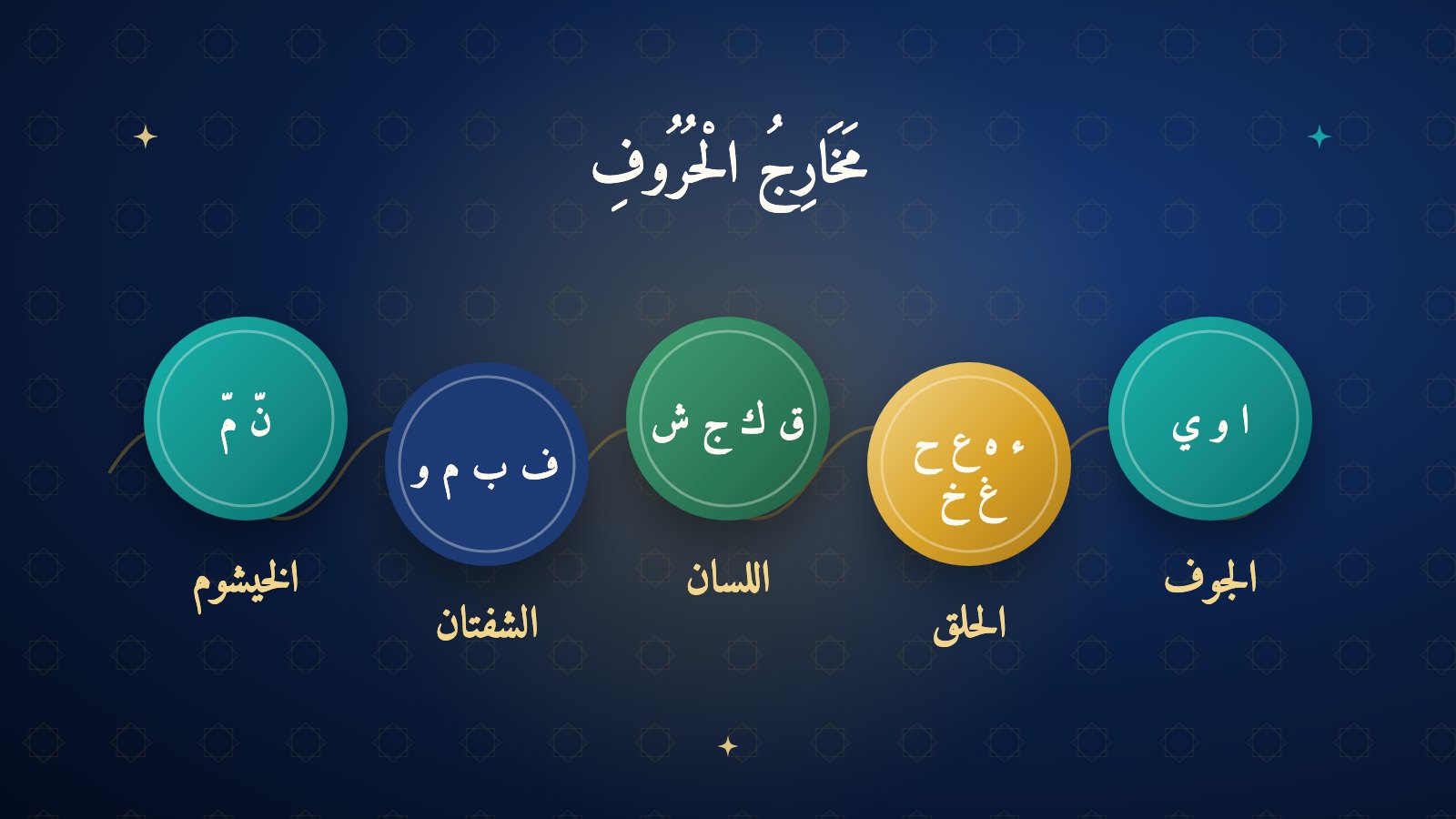
Many mistakes in recitation come from a letter made in the wrong place: a ح that sounds like ه, or a ق that sounds like ك. In tajweed, the place a letter comes from is its makhraj (plural makharij), and scholars group them into five main areas.
1. The empty space (al-jawf)
The open space of the mouth and throat, where the three long vowels come from: the alif in قَالَ, the waw in يَقُولُ and the ya in قِيلَ. They are carried by the breath and do not press on any part of the mouth.
2. The throat (al-halq)
Six letters in three pairs, from the deepest part to the part nearest the mouth:
- The deepest part: ء ه
- The middle: ع ح
- The nearest part: غ خ
3. The tongue (al-lisan)
Eighteen letters are made with the tongue, each in its own spot. A few examples:
- The very back of the tongue against the roof of the mouth makes ق, and a little further forward ك.
- The side of the tongue against the upper back teeth makes ض.
- The tip of the tongue at the roots of the upper front teeth makes ت د ط.
- The tip of the tongue at the edges of the upper front teeth makes ث ذ ظ.
4. The lips (ash-shafatan)
Four letters: ف, from the inside of the lower lip with the edges of the upper front teeth; ب and م, with the lips together; and و, with the lips rounded (the consonant waw, not the long vowel).
5. The nose (al-khayshum)
The nasal passage, where the ghunnah comes from: the humming sound in a noon or meem with shaddah, as in إِنَّ and ثُمَّ.
The test teachers use
Put a sukoon on the letter and a hamzah with a vowel before it: أَبْ, أَقْ, أَحْ. The place where the sound stops is the letter's makhraj.
Practise it
- Work on pairs that are easy to mix up: ح and ه, ع and ء, ق and ك, ث and س, ذ and ز.
- Say each one with the hamzah test, slowly, then inside short words.
- Record yourself and compare with a recognised reciter.
Makharij are hard to learn from text alone. In our tajweed course the teacher listens to each letter live and shows you exactly how to correct it.
Ready to start learning?
Book a free 30-minute lesson with a qualified teacher. No card needed.