
In this article
In tajweed, madd means lengthening a vowel sound. Some long vowels are held for two counts, others for four, five or even six. Getting the length right is part of reciting the Quran as it was transmitted. The lengths below follow the recitation of Hafs from ʿAsim, the most widely read in the world.
What is a count?
A count (harakah) is roughly the time it takes to say a short vowel. Teachers often measure it by folding or unfolding a finger at a steady pace. What matters most is keeping the same pace throughout your recitation.
The three madd letters
- Alif after a fathah: قَالَ
- Waw with sukoon after a dammah: يَقُولُ
- Ya with sukoon after a kasrah: قِيلَ
The main kinds of madd
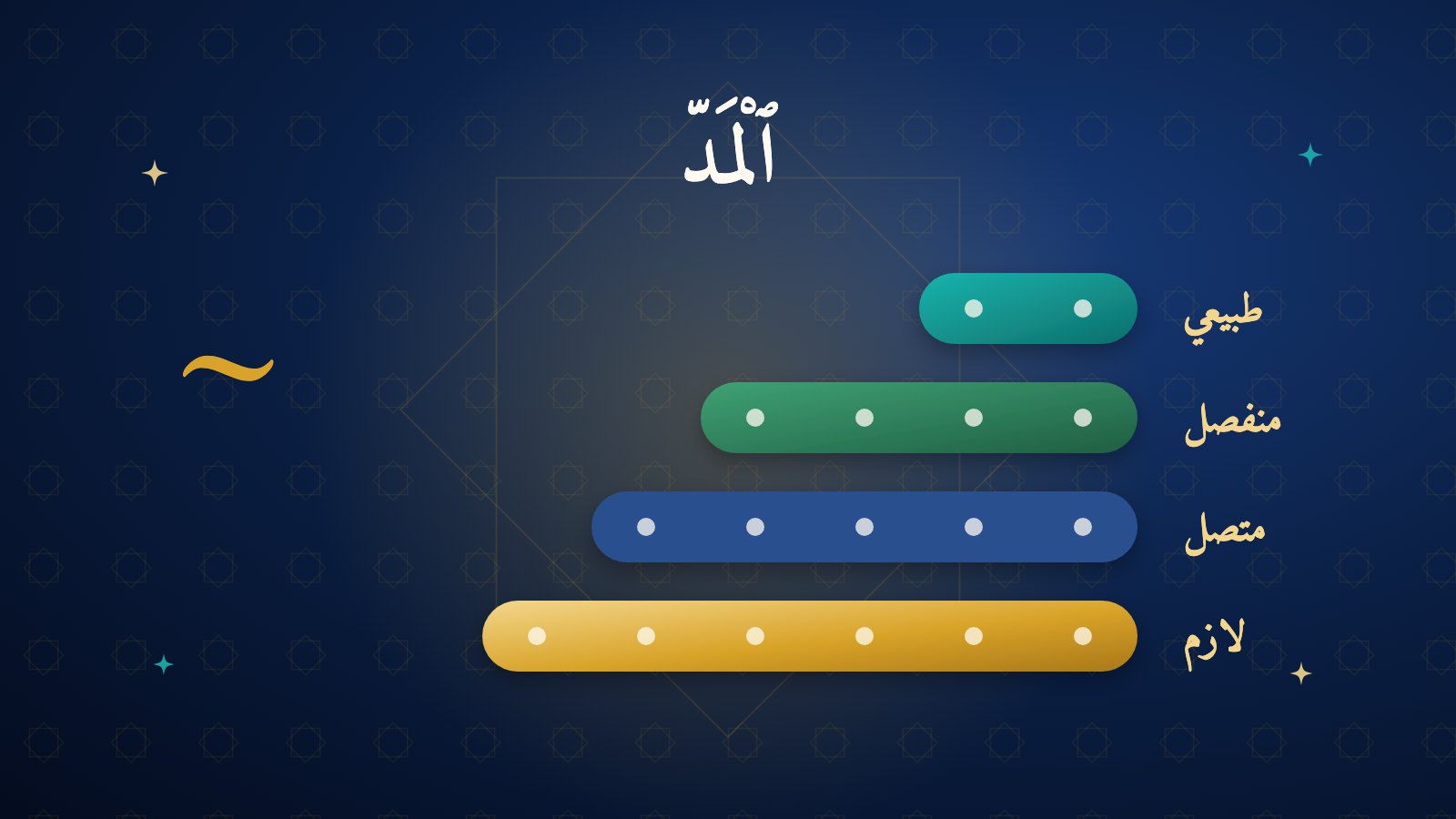
- Natural madd (madd tabiʿi): a madd letter with no hamzah or sukoon after it. Two counts, as in the three words above.
- Connected madd (madd muttasil): a madd letter followed by a hamzah in the same word, as in جَآءَ and ٱلسَّمَآءِ. Four or five counts, and it must be lengthened.
- Separated madd (madd munfasil): a madd letter at the end of one word and a hamzah at the start of the next, as in إِنَّآ أَعْطَيْنَٰكَ. Four or five counts.
- Madd because of stopping (madd ʿarid lis-sukun): a madd letter before the last letter of a word when you stop on it, as in ٱلْعَٰلَمِينَ and نَسْتَعِينُ at the end of an ayah. Two, four or six counts.
- Necessary madd (madd lazim): a madd letter followed by a permanent sukoon or shaddah in the same word, as in ٱلضَّآلِّينَ. Always six counts.
The sign in the Mushaf
In most printed Mushafs a wavy line ~ above the madd letter tells you that this madd is longer than two counts. When you see it, check which kind it is and hold it for the right length.
Practise it
- Recite Al-Fatihah slowly and find every madd in it: there are natural madds, the madd at the end of each ayah, and the necessary madd in ٱلضَّآلِّينَ.
- Keep the same length for the same kind of madd throughout your recitation.
- Record yourself and compare with a recognised reciter.
Madd goes hand in hand with the rules of noon sakinah and the makharij of the letters. In our tajweed course the teacher listens live and corrects the length of every madd as you recite.
Ready to start learning?
Book a free 30-minute lesson with a qualified teacher. No card needed.